
The 24-Hour “Super-Express” and the Desires of Edo
Era: Early to Mid-Edo Period (approx. 1603 – 1780)
1. The Story of Kamagaya: A “World’s Largest Market” Supported by a 450,000 Yen Fish
During the Edo period, Kamagaya was a vibrant area where two critical logistics routes with different purposes converged. At that time, Edo was a massive consumer city with a population exceeding 1 million, significantly surpassing London (approx. 860,000), Paris (approx. 540,000), and even Beijing (900,000). (Source: Tokyo Metropolitan Library: Birth of “Great Edo” – Population)
While most supplies for this massive city were delivered via surrounding seas and waterways, a different kind of “speed” was required for the extremely high-value “Hatsumono” (the season’s first harvest) market.
The Extraordinary Economic Value of the “Hatsumono” Market
Taking “Hatsukatsuo” (the season’s first bonito), which Edo citizens competed fiercely to obtain, as an example, we can compare its price to living standards of the time:
- Price of a single Hatsukatsuo: Approx. 2 to 3 Ryo (Modern value: approx. 300,000 to 450,000 JPY)
- Comparison Indicators (Living standards of the time):
- Monthly income of a master carpenter: Approx. 1.5 to 2 Ryo (Modern value: approx. 220,000 to 300,000 JPY)
- 1 Koku of rice (stale food for one adult for a year): 585 Monme of silver (Modern value: approx. 99,450 JPY)
- The Fact: The price of a single fish was equivalent to more than a month’s salary for a master craftsman, or the cost of staple food for one adult for an entire year. This fanatical culture surrounding “Hatsumono” made ultra-high-speed transport, despite its exorbitant costs, economically viable. (Sources: Cleanup: Edo Sanpaku / HIRO Construction: The Three Star Professions of Edo / Meiji University: Prices in Edo and the Yo-naoshi Ikki)
The “Namakaido” (Fresh Fish Road): A Logistics-Specific Super-Express
The Namakaido, which transported fresh fish from Choshi to the Nihonbashi market in Edo at the fastest possible speed, took a unique route that bypassed the center of Kamagaya-shuku (post town) to the north, taking the shortest possible distance. It is said they could reach Nihonbashi from Choshi in just one and a half days. (Source: National Diet Library: Tenka Tai-hei – Fish and People in the Edo Period – Chapter 2: I want to sell!)
- Lifeline in Winter: In winter, when river water levels dropped and obstacles like shallows increased, the route from Fusa to Matsudo (approx. 7.5 ri) and Matsudo to Nihonbashi (approx. 7 ri) became critical. In the 12th year of Horeki (1762), approx. 3,500 da (1 da equals 10 baskets) were transported. During peak times, as many as 150 horses per day were used to gallop through the Kamagaya area. (Sources: Abiko City History Research Center: Namakaido -Fresh Fish Road(PDF) / Abiko City History Research Center: Bulletin No. 241)
- “Tsukedooshi” and the “Express Fee”: This transport, which involved constantly switching horses and porters without staying at post towns, required “Mashichin” (extra fees) that were more than ten times the standard rate. The additional fee per basket alone reached a modern value of approx. 25,000 to 40,000 JPY. However, in the Hatsumono market where fish traded for 450,000 JPY, this structure generated massive profits even after paying these express fees. (Source: Abiko City: Namakaido. Note: Monetary conversions based on generative AI analysis of historical data)
2. The Disappearing Path: Division by Military Facilities
The current route of the Namakaido seen on modern maps differs from the straight path of that time in some locations.

Part of the Namakaido, which once carried the wealth (Hatsumono) of Edo at top speed, was later divided and disappeared when it became part of the site for Fujigaya Army Airfield (now the JMSDF Shimofusa Air Base) built during the war. Because the original road was blocked by the base, the current path takes a large detour around the perimeter.
- April 1945: Fujigaya Army Airfield completed.
- June 1945: The 53rd Air Regiment moved from Matsudo Army Airfield (now JGSDF Matsudo Camp). (Source: Wikipedia: Shimofusa Air Base)
The fact that part of this historical road was “swallowed” by the base will be highlighted even more clearly in Chapter 4: Modern Military Heritage, by overlaying old maps with modern base boundaries. (Note: Matsudo City Tourism Association [Explanation] Namakaido (Fresh Fish Road): Also recorded on Google Maps)
3. The World (West) at the Time: Scientific Revolution and Enlightenment
While this highly advanced logistics system, adapted to natural conditions (river levels), was operating on Japan’s roads, the Scientific Revolution led by Newton was occurring in Europe.
- The Light of Reason: After the publication of Principia in 1687, Enlightenment thought—attempting to explain the world through mathematical formulas and reason—spread, beginning to break away from medieval values.
- Signs of the Modern Era: Before the Industrial Revolution, technology and wealth were accumulating, laying the foundations for the modern society that follows today. (Source: Kanazawa Institute of Technology: [No. 1] Newton’s “Principia”)
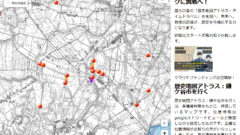
Historical Atlas of Kamagaya City
Let's check out the story! ✋️

👉️👉️👉️Historical Map Atlas: Traveling Through Kamagaya City
Source Data:
- 34 Historical Map Assets
- 1,226 Research Records (Google My Maps)
- System: “Time Travel Map” (Developed by the late Prof. Takanori Sato)

コメント